
Wild Intelligence & the Things the Body Remembers
“If we surrendered to earth’s intelligence, we could rise up rooted, like trees.”
~Rainer Maria Rilke
A few years ago, after a workshop at The Living Centre, an older man wandered slowly through the gardens while everyone else gathered near the kitchen. He stopped beside a patch of lemon balm growing wildly along the path. I watched him rub the leaves between his fingers and lift them toward his face.
He stood there quietly for a long moment.
Then he looked at me and said, “I forgot plants smell alive.”
That sentence stayed with me.
I think many people have forgotten what alive actually feels like.
Food arrives wrapped in plastic beneath fluorescent lights. Water comes through pipes with little thought about springs, minerals, rivers, or rain. Most people spend their days inside climate-controlled buildings staring at screens while their nervous systems absorb endless stimulation. We rush through meals, sleep lightly, breathe shallowly, and wonder why so many people feel exhausted even after doing everything they were told would make them healthy.
Yet the body remembers another way of living.
I have seen this again and again over the years. Someone arrives tired, inflamed, anxious, mentally scattered, emotionally flat. Then something begins to change after a few days of slowing down. Fresh food. Morning air. Walking through the forest. Silence. Real conversation. Good water. Deep sleep. Laughter around a table. Suddenly, their face softens. Their eyes brighten. Their digestion changes. Their breathing changes.
Most of all, their presence changes.
The body responds very quickly when life around it begins feeling real again.
Modern culture speaks constantly about nutrition, wellness, performance, optimization, and longevity. Yet much of the conversation feels strangely disconnected from the living world itself. Human beings evolved outdoors among forests, storms, microbes, rivers, wild plants, sunlight, animals, and seasonal rhythms. The nervous system developed within moving living environments filled with sound, texture, scent, unpredictability, and relationship.
Now many people spend nearly all day indoors moving between artificial light, artificial temperature, artificial food, artificial urgency, and artificial stimulation.
The body adapts because human beings are incredibly resilient. Though adaptation comes with a cost.
I remember walking through a grocery store years ago and realizing almost everything in the middle aisles could sit on a shelf for months without changing. That disturbed me more deeply than I expected. Living things change. They wilt. Ferment. Ripen. Rot. Sprout. Carry scent. Carry bacteria. Carry movement. Much of modern food feels strangely absent of life itself.
A carrot pulled from healthy soil still warm from the sun carries an entirely different energy than something processed beyond recognition in a factory. Most people sense this immediately once they begin eating fresh living foods regularly. Their body feels calmer. Digestion improves. Sleep deepens. Cravings change. Their senses begin waking up again.
Years ago, I spent time with an elderly herbalist who told me, “The body understands fresh things.”
At the time it sounded overly simple.
Now I think he was completely right.
The Quiet Intelligence of Living Things
One of the strangest ideas modern culture has inherited is the belief that human beings exist separately from nature. Intellectually, most people understand this is false. Though emotionally and biologically, many still live as though nature is somewhere else.
The truth feels much closer and far more intimate.
The forest lives in your lungs.
The ocean lives in your blood.
The minerals in your bones once moved through mountains and rivers.
Even the bacteria in your digestive system shape your moods, cravings, immune system, and emotional resilience.
Human beings are ecosystems.
Modern microbiome science continues to reveal how deeply interconnected the body truly is. Trillions of microorganisms live within us, helping regulate digestion, inflammation, hormones, neurotransmitters, and immunity. Researchers now understand that gut bacteria influence emotional states and nervous system function in profound ways.
Traditional healing systems sensed this long ago through direct observation. Ancient systems of medicine always viewed health as a relationship rather than a mechanical repair. Ayurveda, Chinese medicine, Indigenous healing traditions, and herbal lineages throughout the world understood that the body responds continuously to environment, season, emotion, food, climate, rhythm, and consciousness.
A forest thrives through relationships.
So does a human being.
Several years ago, after a heavy rain, I walked into the woods very early in the morning before anyone else was awake. The entire forest smelled alive. Wet cedar. Mushroom-rich soil. Pine needles warming beneath the first sunlight. Everything felt vibrant and awake.
I remember thinking how biologically impossible it would be for the human nervous system to remain untouched by such an environment.
Modern science now confirms what people have intuitively felt forever. Forest environments reduce stress hormones, support immune function, regulate blood pressure, and calm the nervous system. Trees release compounds called phytoncides that interact positively with human biology. Exposure to biodiverse environments strengthens microbial richness within the body itself.
Though honestly, most people already know this without scientific studies.
You can feel it immediately.
Nobody walks quietly through an old-growth forest and says, “I feel worse in here.”
The body recognizes coherence.
Children especially reveal this naturally. Give a child a stream, stones, mud, trees, insects, and open space and watch what happens. Attention deepens. Curiosity emerges spontaneously. Hours pass without boredom. Something instinctive awakens through direct sensory relationship with life.
Then slowly culture trains that attention elsewhere.
Toward screens.
Toward speed.
Toward productivity.
Toward constant stimulation.
Toward abstraction.
I sometimes wonder how many modern illnesses involve a form of sensory starvation. People consume enormous amounts of information while receiving very little direct contact with living reality. They see thousands of images every day, though they rarely watch wind moving through trees for ten uninterrupted minutes.
The nervous system absorbs this difference.
“One can never consent to creep when one feels an impulse to soar.”
Helen Keller
Food, Memory, and Relationship
Food carries memory.
I do not mean memory only psychologically. I mean biologically, emotionally, culturally, even spiritually.
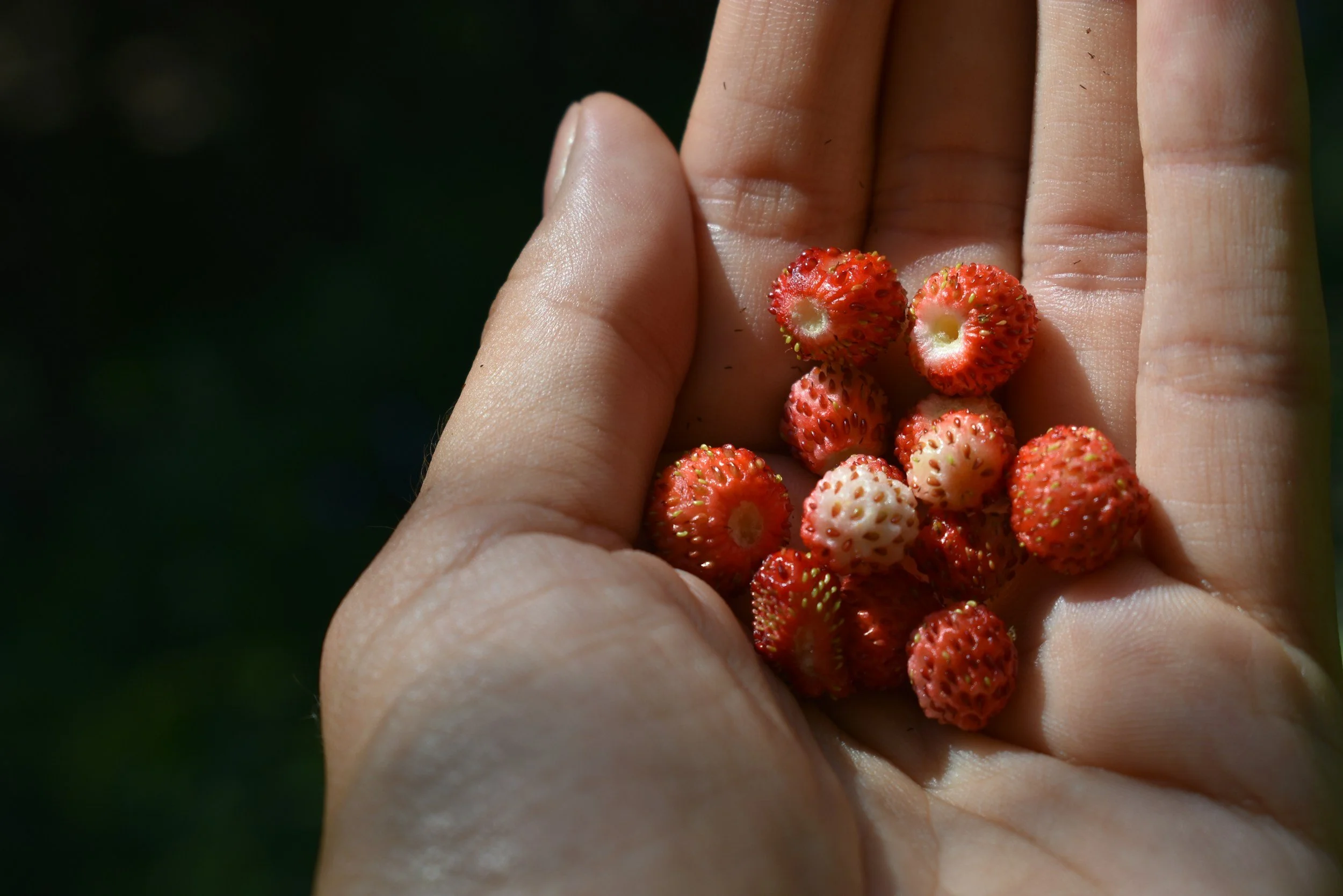
I still remember wild strawberries from childhood summers. Their scent stained into warm fingers beneath the sun. The sweetness tasted different because the experience carried a relationship with place, weather, movement, and season.
Many foods today arrive stripped of context. People eat strawberries in winter without any awareness of seasonality. Tomatoes taste like water because they were bred for shipping durability rather than vitality. Meals happen in cars, in front of screens, during stress, during work, during distraction.
Something important disappears through this pace.
Traditional cultures treated food with reverence because eating connected people directly with life itself. Soil, weather, seeds, sunlight, water, insects, hands, and time all participated in nourishment. Meals created a relationship between people and place.
I think this explains why gardening changes people so deeply.
A person plants seeds and suddenly begins noticing rainfall differently. Sunlight matters again. Soil texture matters. Seasons matter. Patience returns. Participation returns.
Several years ago, a woman attending one of our programs told me that growing sprouts in her kitchen changed her relationship with food more than any diet she had ever followed. Every morning, she watched life emerging from tiny seeds on her counter. She said it reminded her that nourishment was still alive.
I understood exactly what she meant.
Living foods carry vitality that extends beyond vitamins or calories. Fresh herbs, sprouts, wild greens, fermented vegetables, medicinal plants, raw honey, mineral-rich spring water, fresh garden foods, and biodiverse diets communicate something directly to the body.
People often describe this as feeling clearer, grounded, energized, or emotionally stable.
The body understands living things.
At the same time, healing rarely arrives through food alone. People need beauty. Silence. Meaning. Touch. Friendship. Purpose. Movement. Honest conversation. Creative expression. Sunlight. Rest.
Human beings need relationships.
I believe many people are far more lonely than they admit. Modern life surrounds people with stimulation while starving them of depth. Social media creates endless connections without genuine closeness. Many feel emotionally exhausted from constant interaction while quietly aching for something real.
Around the dinner table at retreats, I often watch people slowly begin relaxing after several days together. They eat fresh food. Sit beneath trees. Talk honestly. Put their phones away for periods of time. Something human returns.
People laugh differently when they feel safe.
They breathe differently, too.
The Earth still knows how to heal certain parts of us that modern culture struggles to reach.
Not because nature is magical or sentimental.
Because human beings evolved within a relationship with living systems for thousands upon thousands of years.
The body remembers.
I think this is why so many people feel emotional standing beside oceans or beneath ancient trees. Some deeper layer of awareness recognizes home.
For those who feel drawn toward exploring this relationship with living foods and ecological nourishment more deeply, I would love to invite you to join me for a very special online gathering titled Goin’ Wild for Wild Living Foods.
This free one-hour webinar will explore the profound vitality available through wild plants, fresh living foods, sensory awareness, and direct relationship with nature’s original intelligence. Together, we will look at how living foods support digestion, resilience, emotional clarity, and whole body nourishment in ways that go far beyond modern nutritional thinking.
I will also be sharing entirely new material and perspectives that I have never presented publicly before. Much of this evening comes from recent reflections, experiences, and insights that have continued unfolding through my work with ecological healing, wild foods, consciousness, and human relationships with living systems.
The evening is designed to feel immersive, grounded, practical, and deeply alive.
Goin’ Wild for Wild Living Foods
Free Webinar
Thursday, May 21, 2026
7:00 pm to 8:00 pm EST
Sometimes a single conversation can reopen a doorway that the body has quietly been waiting to walk through for years.
“To forget how to dig the earth and to tend the soil is to forget ourselves.”
Mahatma Gandhi