

The Tongue as an Emotional Mirror
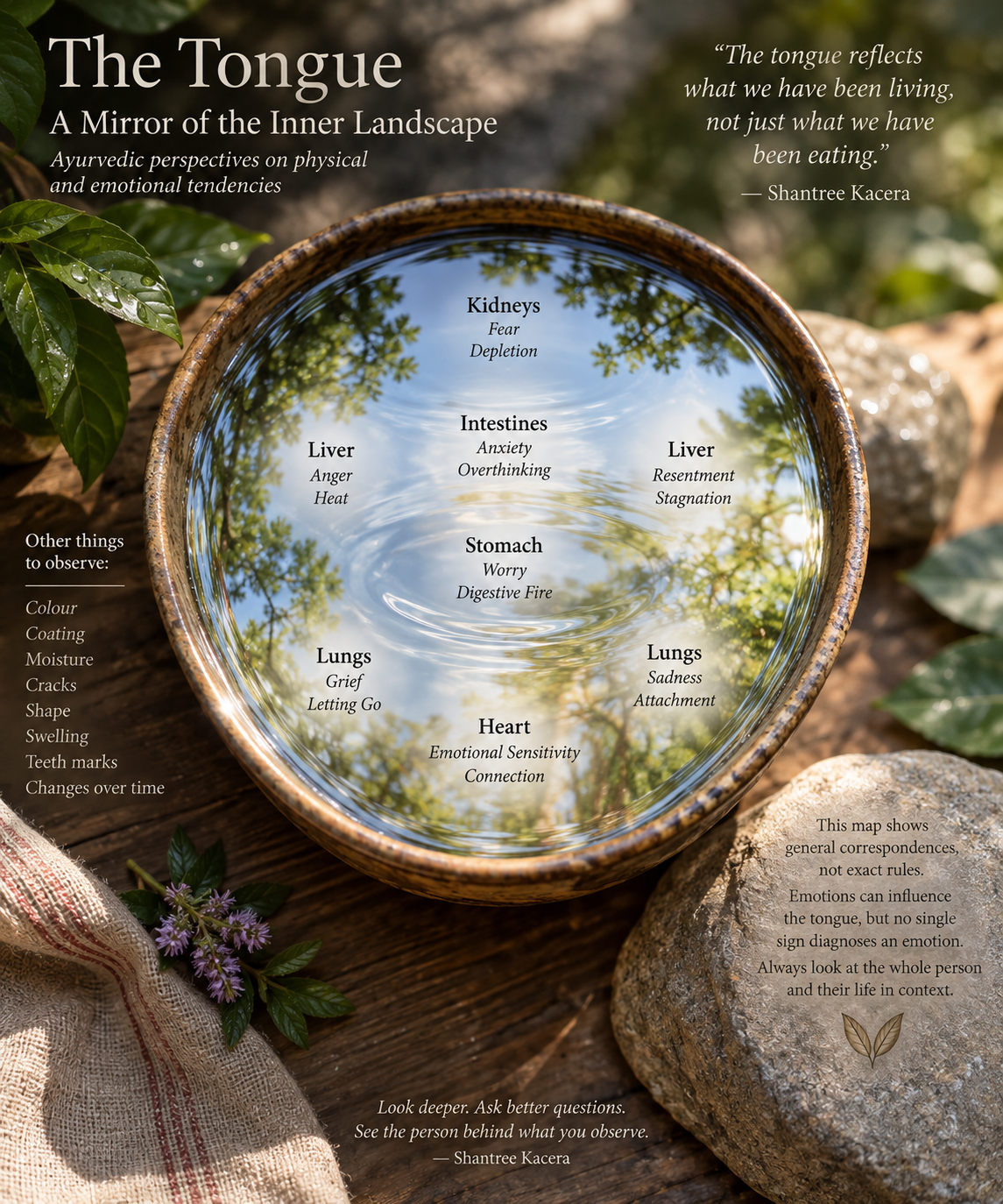
The tongue carries echoes of what the whole person has been living.
How the Inner Life May Leave Visible Traces
“A tongue never comes into the room by itself. A whole person is standing behind it, and a whole life that has brought them to this moment.”
~Shantree Kacera, RH, DN, Ph.D.
I have looked at thousands of tongues over the years. After many decades, you would think I would have become quite certain about what I am seeing, but almost the opposite has happened. I probably have more questions now. I know the classical signs, the maps, the doshas, the tissues and the different areas we are taught to observe, and all of that has been useful. Then there is the person standing there in front of me, and people have never fitted very well into charts. That is part of what has kept tongue diagnosis interesting to me for so long.
I remember beginning to notice years ago that someone's tongue could look different when something in their life had changed. A person would return to see me and perhaps the tongue was drier, the coating had changed, or there was something about the colour or edges that caught my attention. As we talked, I might learn that the last few months had been very difficult. A parent had died, a relationship had ended, they had been caring for someone who was ill, or they had hardly slept for weeks. Sometimes nothing dramatic had happened at all. There had simply been too much work, too little rest, worry about money or family, or that kind of ongoing strain that becomes so familiar we almost stop noticing it.
Over time I began wondering how much of our emotional life eventually finds its way into the tissues of the body. We use the word emotional as though emotions live somewhere in the mind while the physical body goes on doing something else, but our own experience tells us otherwise. Fear can dry the mouth in seconds. Bad news can take away the appetite before we have even thought about eating. Worry can keep the gut churning half the night. Grief can change sleep, hunger and energy for months. Anger can tighten the jaw and change the way we breathe. We know these things because we have lived them, which made me curious about what might also be happening to the tongue during those times.
There Is More Than a Tongue in Front of Me
When I examine a tongue I still look at all the things I have always looked at: colour, coating, moisture, shape, cracks, the tip, sides, centre and back. I notice what catches my eye and whether anything has changed since I last saw the person. But quite often what I want to know next has little to do with the tongue itself. How did you sleep last night? Has your digestion changed? What have you been eating lately? Have you been travelling? Are you exhausted when you wake up? When did you first notice this change? And increasingly over the years, I have found myself asking a very simple question: What has been happening in your life?
That question has become more important to me as I have grown older because there have been plenty of times when I thought I knew what a sign meant and the person sitting in front of me taught me otherwise. There are many reasons for a dry tongue and many reasons for a coating. A crack does not permit me to announce that someone is carrying grief, fear or anger. Tongue diagnosis becomes much less useful when every little mark is given some grand meaning. I am more interested in whether several things are changing together and whether those changes continue over time.
If I have a photograph from three months ago and the tongue looks quite different today, then I have something worth asking about. Was there an illness? Did the person's food change? Did they begin a medication? Were they fasting? Had they been sleeping badly? Did something happen in the family? Sometimes there is an obvious connection, and sometimes there isn't. Earlier in my practice, I probably felt a stronger need to find the answer. These days I am much more comfortable leaving some things open and watching what happens next.
Ayurveda Gave Me a Place to Begin
When I first came to Ayurveda, I was drawn to the way it looked at the whole person. The Elements of Vata, Pitta and Kapha gave me a language for things I was already beginning to notice, but over the years I have tried to be careful about turning that language into another set of boxes. Vata can become restless, and there may be worry, fear, poor sleep, dryness and irregular digestion. Pitta can become hot and intense, sometimes with frustration, impatience and digestive disturbance. Kapha has another quality, with heaviness, slowness, withdrawal or that feeling of being unable to get moving again.
These observations can be useful, but then a real person walks through the door and mixes everything up. A Pitta person becomes frightened. A Kapha person can't sleep. Someone who has always appeared very Vata becomes intensely angry about something that happened twenty years ago. Human beings are complicated, and after working with people for this long, I am grateful for that complexity because it keeps me from becoming too certain about what I think I know.
This is also why I hesitate when I see tongue charts claiming that a particular mark means grief, another means anger, and something else means fear. There may be something there worth exploring, and I remain curious about those relationships, but first I want to meet the person. If someone tells me they have been grieving for six months and I also see changes in sleep, appetite, digestion, energy and the tongue, then I become interested in the whole picture. The tongue hasn't diagnosed the emotion. It has simply become part of what I am observing.
What You Might Discover for Yourself
You don't need fifty years of experience to begin looking at your own tongue. You only need enough curiosity to keep looking for a while without deciding too quickly what everything means. Over time, you may begin to notice:
• How your tongue looks during stressful periods and whether anything changes when life settles again.
• Whether digestion and emotions seem to change together, particularly during worry, grief, excitement or prolonged pressure.
• What several nights of poor sleep look like for you, if they show up on the tongue at all.
• How travel, fasting, hydration and changes in food affect what you see, sometimes within a surprisingly short period of time.
• Patterns that become visible only over time. One morning gives us very little to compare, while thirty mornings can become quite interesting.
• What your own normal tongue actually looks like, rather than continually comparing yourself with photographs of other people's tongues.
• A greater awareness of your own body and its changes. For me, this may be one of the most useful parts of the whole practice.
Try Thirty Mornings
Take a photograph tomorrow morning before brushing your teeth, eating or drinking anything. Try to use approximately the same light each morning, and continue for thirty days. You don't need to spend much time studying the photographs at first. Perhaps write a few words each day about what is actually happening: slept well, very tired, worried, peaceful, digestion off, lots of energy, argument yesterday, ate late, wonderful day. Keep it simple enough that you will actually continue doing it.
We have become very good at turning every small change in the body into something that needs fixing. We see a crack and immediately search for what it means. We notice a coating and want to remove it. Something looks different, and suddenly we are worried. I would rather begin by watching. Bodies change from one day to another, and what interests me is what continues, what disappears, what comes back and what else is happening when it does.
After two or three weeks, go back through the photographs and see what you notice. Perhaps the coating became heavier for several days, and your digestion was different at the same time. Maybe the tongue was unusually dry during a week when you were barely sleeping. Perhaps something changed after travelling, fasting or eating differently. You may also discover that a difficult emotional week produced no obvious change whatsoever. That is useful information too because observation only means something when we are willing to see what is actually there rather than what we expected to find.
You can also put your emotional notes beside the photographs. Maybe there was a difficult day, an argument, some good news, several days of anxiety, a beautiful afternoon outside, or a period when you finally felt rested after weeks of being tired. I wouldn't work too hard at trying to make these things fit together. If there is a pattern, let it emerge slowly. Sometimes we see more when we stop trying so hard to find an explanation.
I Trust the Questions More Now
Earlier in my life, I wanted to know exactly what everything meant. I wanted the tongue maps, the organ relationships, the tastes, herbs, foods and doshas, and I spent many years learning them. I am grateful for that foundation, and I continue to use it. What has changed is the certainty I once had that everything I saw needed an immediate explanation.
Working with tens of thousands of people had something to do with that. People kept surprising me. A tongue I expected to look one way looked completely different. Something I thought was important disappeared by the next visit. A mark I expected to change remained there year after year while the person felt perfectly well. Someone else's tongue looked fairly ordinary while they were struggling terribly. Eventually I began listening more carefully to what people were telling me and holding my own interpretations a little more lightly.
The emotional part of tongue diagnosis has made me even more cautious because we carry our lives so differently. I have known people who could barely eat after a loss and others who ate constantly. Some people become restless under pressure while others become exhausted and withdraw. Some talk about what is happening immediately, while others carry something for years. I have met people who seemed remarkably well while moving through enormous difficulty, only to feel the physical effects months later when everything finally became quiet. I keep wondering where all of that lives in the body and whether some of it occasionally becomes visible on the tongue.
I don't have a neat answer to that question, and after all these years I don't feel that I need one. Maybe some emotional experiences leave visible traces, and others don't. Perhaps the more useful thing is simply to keep observing and asking. When I stop looking only for signs and begin asking about the person's life, I nearly always learn something that I would have missed by looking at the tongue alone.
One question has stayed with me more than most: What have you been living through? It changes the conversation. The tongue belongs to someone who has been sleeping or lying awake, eating well or losing their appetite, worrying, loving, grieving, working, resting, growing older and responding to whatever life has placed in front of them. Once I remember that, the tongue becomes less of a chart to decode and more of one small part of a much larger human story.
Perhaps that is why I still haven't grown tired of looking after more than fifty years. I still use the maps and pay attention to colours, coatings, cracks and all the things I was taught to observe, but I trust the questions more than I once did. The tongue can give us clues, sometimes very useful ones, while the person and their life give those clues context. There is always something else to learn, and I suspect there always will be.